AI readiness earns CX a seat at the boardroom table
The CX leaders who earn a seat at the boardroom table aren’t the ones deploying the most technology. They’re the ones making the smartest investment decisions. Camila Ferreira explains
Add bookmarkListen to this content
Audio conversion provided by OpenAI

Right now, artificial intelligence (AI) dominates executive agendas. Boards are asking about it. Budgets are being approved. Teams are being told to “do something with AI.”
But amid the rush to adopt new tools, many organizations are skipping more fundamental questions: Is this even the right problem to solve? And is it worth solving at all?
Because AI doesn’t create credibility for customer experience leaders. Leadership does. Technology doesn’t earn influence. Economic results do.
After working with CX and operations teams across multiple industries and growth stages, I’ve seen a consistent pattern: the organizations that succeed with AI aren’t faster at implementation. They’re more disciplined about readiness.
They treat AI as an accelerator; not a shortcut. And that discipline follows a clear sequence: not a technology roadmap, but an investment logic.
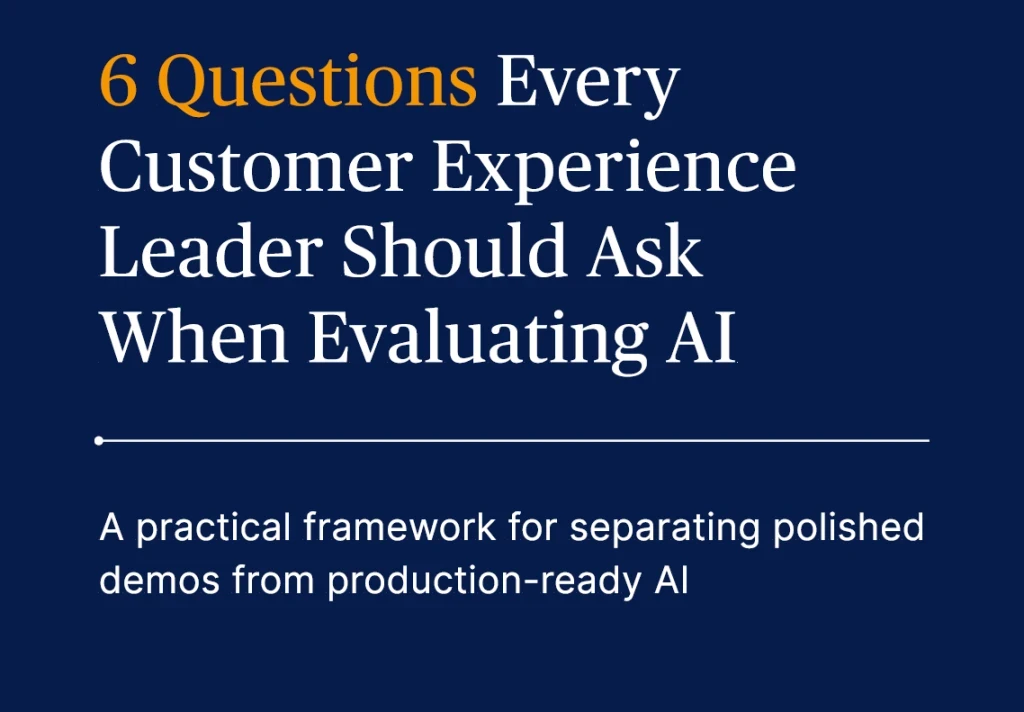
This article outlines six essential steps to take to ensure AI is being treated - and deployed - in a way that will drive results, rather than multiplying chaos.

Don't miss any news, updates or insider tips from CX Network by getting them delivered to your inbox. Sign up to our newsletter and join our community of experts.
1. Define the problem
Before discussing tools, define the problem with precision. Not “improve service.” Not “modernize support.” Not “add automation.” Those are initiatives, not problems.
Executives fund problems that are concrete, observable, and measurable:
- Where exactly is the friction?
- What is breaking down?
- What is slowing teams or frustrating customers?
If the issue can’t be clearly articulated, it can’t be fixed, and it certainly can’t justify investment.
Clarity at this stage prevents organizations from chasing trends instead of solving real constraints.
2. Validate it with data
Next, confirm that the problem is real, and material.
Customer experience leaders often rely on anecdotes or isolated complaints, but the boardroom acts on evidence. Data transforms intuition into credibility.
- How frequently does the issue occur?
- What trends are visible over time?
- What operational or behavioral data supports it?
- Where is it concentrated?
Data transforms intuition into credibility. Without it, every initiative feels like an opinion. With it, decisions become objective.
This is where many AI conversations should end. Because sometimes, once the data is examined, the problem is smaller than assumed, or solvable through simpler changes.
Not every issue deserves automation.
3. Quantify the financial impact
Only after the problem is defined and validated should leaders ask the most important question: Is this worth the investment?
This is where CX either earns influence, or loses it.
Translate the experience gap into financial terms:
- Revenue at risk
- Cost-to-serve
- Productivity loss
- Churn or expansion opportunity
If you cannot express the issue economically, it will never compete for budget. Every initiative competes against others (marketing, sales, product, technology), all promising returns.
AI is not cheap. Neither is organizational change. So the bar should be high.
If the impact isn’t material, it shouldn’t be prioritized. This step alone separates strategic CX leaders from tactical ones. Strategic leaders speak the language of investment.
4. Design the process before automating
Never automate a broken process. Automation scales whatever already exists, good or bad. Simplify and standardize first. Then digitalize.
If a workflow contains handoffs, rework, or manual fixes, AI will only make those inefficiencies faster and more expensive.
Before introducing technology, simplify. Standardize. Remove unnecessary steps. Eliminate friction.
Only when the process is stable should you digitalize or automate it. Otherwise, you risk embedding today’s problems permanently into tomorrow’s systems.
5. Align culture and communication
Technology adoption is not a technical challenge. It’s a human one.
Even well-designed solutions fail when teams feel threatened, excluded, or unclear about what’s changing.
Communicate the purpose, involve teams early, and clarify how roles evolve. AI should remove repetitive tasks so people can focus on higher-value work.
When AI is perceived as replacement rather than enablement, resistance is inevitable.
Leaders must intentionally manage the narrative:
- Why are we doing this?
- How will roles evolve?
- What new capabilities are we building?
- How does this make work better, not harder?
AI should remove repetitive tasks and free people to focus on judgment, empathy, and complex problem-solving, the work that actually creates great experiences.
When teams see technology as support, adoption accelerates. When they don’t, even the best tools sit unused.
6. Implement AI where it accelerates value
Only now, after the problem is clear, validated, financially justified, operationally sound, and culturally supported, does AI become the right move.
At this stage, technology becomes leverage, not risk. Results show up in metrics executives care about: lower costs, faster resolution, higher retention, and improved productivity.
Not experimentation. Outcomes.
AI is powerful, but it isn’t magic. It magnifies whatever already exists.
The CX leaders who earn influence don’t start with tools. They start with leadership.
In the boardroom, credibility doesn’t come from innovation alone. It comes from demonstrating that every investment drives measurable business results.
Technology might transform experiences.
But readiness is what earns CX a seat at the boardroom table.
Quick links
- There’s no point in great CX if it doesn’t create revenue
- AI search and loyalty: Why the first question matters more than the last purchase
- 6 Omnichannel strategies that actually increase engagement