Diesel and Marni parent group rolls out Virtual Try-On experience
Following in the footsteps of Macy’s, Ralph Lauren, and Gucci, OTB becomes latest fashion business to experiment with VR and AI-powered experiences for customers
Add bookmarkListen to this content
Audio conversion provided by OpenAI

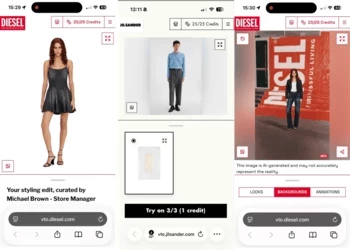
OTB Group, the parent company of Diesel, Jil Sander, Maison Margiela, Marni, and Viktor&Rolf, is rolling out a new Virtual Try-On experience that allows shoppers to visualize exactly how specific items will look and fit on their own bodies.
Promising a "high degree of realism", the group says the experience is designed to create a "personalized shopping experience that bridges the gap between digital browsing and the physical fitting room".
The new experience is enabled by a generative AI API on Google Cloud's Gemini Enterprise Agent Platform. It will initially be introduced for Diesel and Jil Sander across the United States and Europe, and will expand in the coming months to Marni and Maison Margiela, followed by a rollout to additional markets.
According to OTB Group chairman and founder Renzo Rosso, the innovation is an example of the power of human-AI collaboration, and the creativity it can unlock.
Rosso said: "I have always believed in technology as a strategic lever to enhance human talent, at the service of people and creativity. In this context, artificial intelligence represents an extraordinary opportunity to make the customer experience more advanced, engaging and personalized."
"This project brings to life a vision I have been nurturing for over three years, made possible thanks to Google's best-in-class expertise in AI. I am confident this is the natural direction for the evolution of e-commerce and clienteling, and a key driver of growth for the future of the fashion industry," Rosso added.
Don't miss any news, updates or insider tips from CX Network by getting them delivered to your inbox. Sign up to our newsletter and join our community of experts. 
Omnichannel commerce in the AI age
As outlined by Rosso, this is an AI use case designed to augment and enhance human expertise, rather than replace it. It also expands the omnichannel experiences that underpin the brand-client relationship, helping OTB's brands to meet customers on the AI platforms they increasingly favor. But it also aims to bridge the gap between digital and physical CX.
The project aims to leverage AI to tempt customers into brick and mortar stores via "high-quality AI visuals" that will inspire prospective customers to "experience the products firsthand".
As such, the virtual try-on service will be positioned as a premium clienteling tool by OTB Group, giving its advisors a new means by which to share curated, hyper-realistic visual previews with selected customers, and transforming how the two parties interact.
OTB Group says the experience will deliver "a sophisticated, high-touch service that transforms standard interactions into highly customized experiences at scale", while building closer client relationships.
The try-on is enabled by Google Cloud's portfolio of AI products, including Gemini Enterprise Agent Platform and Gemini models. The solution can be tailored to the specific needs of different markets and brands as OTB continues the roll out.
"Technology is at its best when it solves real-world challenges for the customer," said Matt Renner, president and chief revenue officer, Google Cloud. "This collaboration demonstrates how Google Cloud's AI can elevate the role of the retail team beyond automating tasks. By integrating Google Cloud's Virtual Try-On, OTB Group is pushing past standard transactions to provide client advisors with the AI tools needed to deliver deeply personal, confident shopping experiences at a global scale."
However, this is more than just a virtual mirror.
Beyond the initial features, customers can use AI image editing, built with Google's Nano Banana, to place themselves within the latest campaign from Diesel and Jil Sander, or place themselves in fashion events, then bring those images to life with video generated by Google's video creation LLM, Veo.
Virtual try-ons and AI-powered fashion, a history
OTB Group isn't the first to offer such experiences. In fact, digital marketing and high-tech CX have long underpinned fashion, with Gartner's Luxury 2021 survey finding brands were spending an average of 33 percent of their advertising budget on digital marketing at the start of the decade.
However, things really took off in the 2010s.
In 2015, US luxury fashion retailer Neiman Marcus, pioneered a digital mirror, which offered a 360-degree to see how outfits look from different angles. Customers could view items can in different colors, and the images were shareable so customers could get the opinions of friends and family. This was followed in 2018 by Gucci's Hallucination VR feature for in-store and online customers.
The fashion industry was also a first and serious mover in the metaverse hype that dominated digital CX in the early 2020s, with a Metaverse Fashion Week (MVFW) launched in 2022. In the years since, MVFW has featured shows from brands including Dolce&Gabbana, Etro, IKKS, and Elie Saab.
The likes of Gucci, Balenciaga and Burberry even created digital clothing and accessories to be worn by avatars in virtual meta-worlds.
In 2020, French department store Printemps launched a blended physical and digital buying journey, leveraging VR through its website using Web 3 technology. In late 2022, it started giving away NFTs as it stepped into the metaverse.
That year, digital marketing director Morgane Lopes told CX Network: "Our objective is not really to boost sales but mainly traffic and the number of omnichannel clients. The question for us was: how do we convert monochannel clients to omnichannel ones?"
While Meta has now started to pull back on its metaverse ambitions, in fashion and retail immersive and VR experiences have been swapped or blended with conversational experiences, enhancing how customers navigate the digital ecosystems of individual brands and retailers.
In 2025 Ralph Lauren unveiled its Ask Ralph conversational AI shopping assistant. Designed to bring the in-store stylist experience to customers' mobiles, it is available in the US to Apple and Android users and marked a significant step in the luxury brand's digital CX strategy.
Meanwhile, Macy's saw a notable increase in customer spending in 2026 thanks to its new AI-powered shopping assistant, Ask Macy's. Early figures showed users were spending up to 400 percent more than shoppers who were not using the tool.
Quick links
- AI could drive 37% of customer interactions by end of 2026
- Retail traffic from LLMs up 393% year-on-year
- Bank of England speculation sparks backlash against dynamic pricing
This CX Network report explores how practitioners are overcoming the three challenges of AI agent integration. Featuring insights from workforce, service and product specialists at Roche Pharmaceuticals, LG Electronics, PowerPay, J.P. Morgan Chase & Co., New York Life and Botpress, as well as a case study from Super Dispatch, it explains how to build for complex tickets and real-world scenarios, how to reduce overheads without reducing headcount, and how to implement the guardrails that are essential to success. Botpress - The realities of using AI agents for the helpdesk