10 trends changing CX in 2026
From AI to consumer privacy, discover how CX is being driven by high-tech tools
Add bookmarkListen to this content
Audio conversion provided by OpenAI


In recent years the foundations of modern CX – such as personalization, self-service, and digital experiences – have changed, giving way to cutting-edge technologies that deliver state of the art capabilities for organizations and enhance CX both directly and indirectly.
CX Network's annual research into the state of CX has confirmed this in several ways. In December 2025 and January 2026, we conducted an extensive research project among 342 practitioners from APAC, EMEA and the Americas. It aimed to establish the top customer behaviors, strategic priorities, investment plans, challenges and trends influencing CX at present.
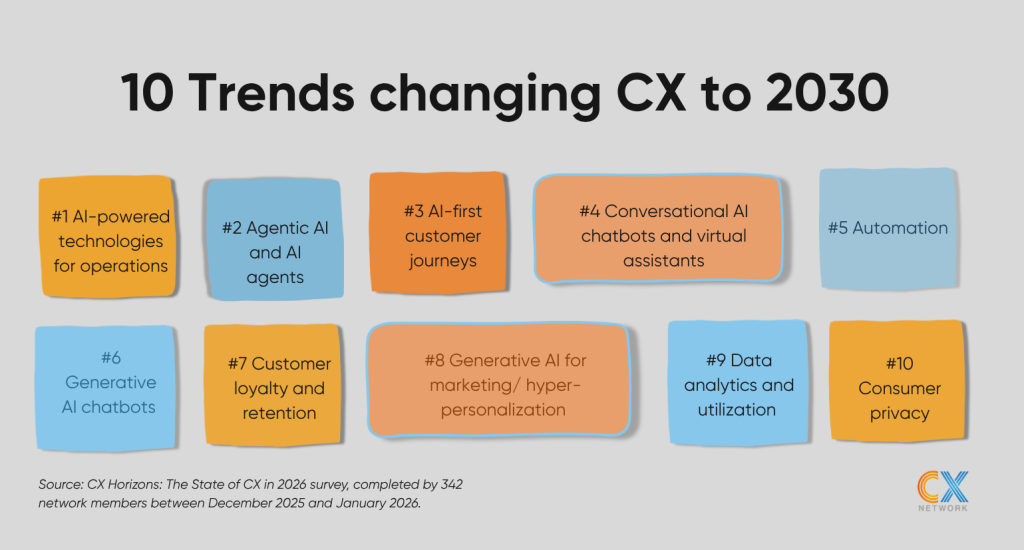
This article takes a closer look at the top 10 trends our survey respondents believe will shape their work to 2030.

Don't miss any news, updates or insider tips from CX Network by getting them delivered to your inbox. Sign up to our newsletter and join our community of experts.
This year's top trends in focus
In 2026, the top 10 CX trends selected by survey respondents reflect how CX is being changed from the outside, by innovations from Big Tech and new tools that are being applied across the business world.
As outlined, this has seen key CX foundations, from loyalty to personalization, replaced with AI-powered tools. This year, among the top 10 trends, six directly relate to the use of AI to enhance business operations, as well as customer-facing processes and experiences.
Trend 1: AI for operations
For the second consecutive year, AI for operations is the leading trend influencing CX. While in 2025 this reflected the rapid adoption of agents and co-pilots, in 2026 it can be seen as an indication that agentic commerce is driving organizational change.
In the past, human customers selected organizations and brands based on emotive factors, such as how much they like a product or service, or how strongly the advertising and marketing campaigns resonated.
Today's algorithmic buyers assess organizations based on how well their business functions. Are customers happy? Do processes work? How do customers benefit from a loyalty program? What do people say about product quality and after-care processes?
Performing on these fronts requires connected and coherent processes behind the scenes, as well as machine readable content.
Trend 2: Agentic AI and AI agents
Agentic AI and AI agents are increasingly embedded in business tools to reduce manual work and improve processes, elevating efficiency and improving customer and employee experiences.
This is because agentic AI is a self-driven problem solver. Unlike traditional AI, which follows predefined instructions, agentic AI can break down complex tasks, plan and execute the necessary steps, and provide real-time updates on progress and outcomes.
On the other hand, AI agents for CX are software systems that can complete tasks autonomously with minimal or no human interaction. An AI agent uses reasoning, memory and the ability to learn and adapt to complete these actions. These machines can interact with humans and manage increasingly difficult tasks. They can also be personified to adopt a "brand voice" and bring a level of personalization to automated journeys that has not been possible before.
Trend 3: AI-first customer journeys
Also known as agentic commerce, AI-first customer journeys are those journeys initiated in an AI-powered conversational interface, such as ChatGPT, Gemini, or Claude. In many cases, customers can now complete transactions within the interface without direct contact with the retailer.
So influential are AI-first journeys, that in addition as emerging as a top CX trend, the research confirmed they are also a top customer behavior. And our research is not alone in finding this.
According to Braze, by the end of 2026, more than one third of shoppers in the UK will turn first to an AI assistant or LLM when shopping, instead of a search engine or brand. Meanwhile, figures from Adobe confirm retail web traffic from LLMs increased 393% between 2024 and 2025.
Trend 4: Conversational AI chatbots and virtual assistants
Not entirely unrelated to trend three, conversational AI chatbots and virtual assistants are also growing in popularity, ranking one place higher in 2026 than in 2025, and two places higher than in 2024.
Written and spoken conversational experiences are now a cornerstone of CX, bringing value to retail discovery, post-purchase engagement and care, and proactive engagement, as well as retention and recovery. The draw for consumers is clear: when it comes to completing tasks, they value speed and convenience and prefer to communicate using natural language.
Trend 5: Automation
Automation once again held its place as a trend of substantial but not critical importance, Automation of CX and service functions also emerged as the second most important investment priority in 2026.
Babul Balakrishnan, senior vice president of customer experience for Thunes, says investment in automation should be prioritized because "scale has finally caught up with us". He explains: "Manual workarounds, top agents, and 'we'll fix it later' processes or methodologies no longer survive volume, complexity, or customer expectations. Automation isn't and shouldn't be about replacing humans; it's about removing friction so humans can show up where judgment and empathy actually matter."
Trend 6: Generative AI chatbots
When practitioners were asked where their customers encounter generative AI in a typical journey, the most selected answer was in customer support. Generative AI chatbots are transforming how customer inquiries are triaged and escalated – and the technology is also being applied beyond support.
For example, Swiss Airlines has a generative AI-powered chatbot called Heidi, which helps customers discover new travel opportunities by asking about their specific holiday preferences and bringing them fresh ideas to inspire, rather than support bookings.
Trend 7: Customer loyalty and retention
One of only two trends in the top 10 that does not directly relate to a technology, loyalty and retention remain key considerations for CX practitioners. Elsewhere in the research, we once again found that the top strategic aims for organizations in 2026 – by a significant margin – was to grow the customer base. Selected by 60 percent of respondents it was followed by drive more sales (39 percent), and reduce handle, wait times, and lost inquiries (37 percent).
However, in a trading environment where algorithmic buyers are gaining ground, loyalty is changing. As Anjali Jain writes: "The challenge and opportunity for organizations is to build loyalty in a world where intent, not channels, defines the starting point."
Loyalty programs must also now be machine readable. James McIntyre, CCXP says: "Most loyalty leaders are treating this like a technology issue. The harder problem is visibility: can an agent actually see the benefits at the point of decision. If your program's benefits aren't structured for an AI agent to find, read and apply in real time, they don't exist at the moment the decision is made."
Trend 8: Generative AI for marketing/ hyper-personalization
Although the research found 32 percent do not currently use generative AI, its application for marketing and hyper-personalization continues to be popular. Campaigns by Coca-Cola, BMW, Moncler and McDonalds have all leaned heavily on generative AI, while other organizations use it to tailor marketing and experiences to the individual needs of specific customer groups.
However, it should be used with caution. Jacqueline Bourke, Getty Images' senior director of creative for EMEA, says "brands should be thinking strategically about the use of this technology".
"While consumers enjoy using AI to create images and art, they still view AI-generated works as less authentic and less valuable than human-made content, especially in advertising where they hold brands to a higher standard," Bourke explains.
Trends 9: Data analytics and utilization
Perhaps the most surprising result was data analytics and utilization dropping to ninth most important trend, only two years after holding the top spot.
Data is the foundation of AI implementation and, according to principal consultant at M4 Sue Duris, one of five foundations of a successful AI deployment. She says: "Assess the current state of your data: Is your data clean, structured, and accessible? How will it interact with learning models? Build processes to ensure diversity and prevent bias in training data, and establish quality assurance mechanisms."
According to Jaslyin Qiyu, CMO and head of CX for Singapore and Australia for Cigna Healthcare and a CX Network Advisory Board member, customers increasingly understand they're trading data for convenience but not without expectations: they instinctively expect smart strategies that make this exchange both "explicit and valuable".
Trend 10: Consumer privacy
Consumer privacy is becoming more influential to the work of practitioners, entering the top 10 for the first time this year. This is not unrelated to the prominence of AI and data-dependent technologies that comprise the rest of the top 10 and when it comes to the top customer behaviors, awareness of how AI works and uses customer data emerged as the leading behavior influencing the work of practitioners in 2026.
Joshua Curtis, CX Network Advisory Board member and customer care center manager at Super Retail Group, says: "Privacy has moved from being a policy discussion to an experience one, and that's why it's now firmly on the CX agenda."
What the top trends mean for CX to 2030
In the last three years, the top trends influencing the work of practitioners have shifted to encompass more AI tools, while CX strategies, such as loyalty and retention and employee experience have dropped down – or off – the list.
We have also seen self-service and terms such as digital CX become less important to practitioners over this time.
Here is the three-year trend:
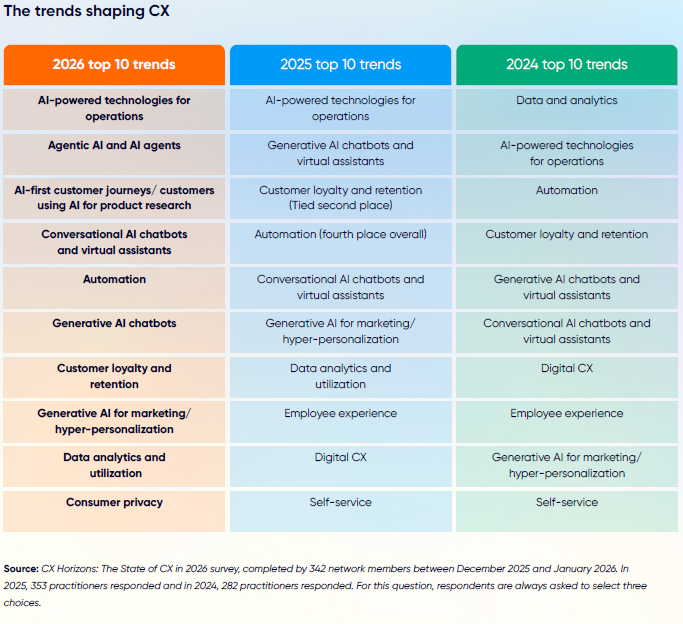
The results indicate CX has truly entered its AI Era, drastically changing the foundations and fundamental laws it was built on. This brings near infinite possibilities for the improvement of processes, experiences, and even career development paths, but practitioners must remember these technologies require ongoing optimization, tuning and updates, QA processes, and model maintenance.
This means humans are as important as ever to CX, and organizational readiness and change management are paramount.
"The rise of generative and agentic AI has only just started to transform how CX is delivered," says Greg Thomas, senior director of thought leadership for Genesys. "In 2026, organizations will focus on turning investments in AI into measurable results at scale, doubling down on orchestration via strategic CX platforms, and deploying AI in ways that protect brand safety and operate within clear guardrails."
Explore the CX Horizons series:
- 10 trends changing CX in 2025 and how to embrace them
- 5 Things to know about the state of CX in 2026
- How practitioners are spending their CX budgets in 2026
- How to tackle 5 challenges facing CX in 2026
- How to connect with customers in the AI age