Sometimes bigger is better: What the rest of the world can learn from US grocery stores
Self-confessed check-out geek Claire Cunningham toured the supermarkets of her native US and identified six things the global grocery sector could do to make their experiences better
Add bookmarkListen to this content
Audio conversion provided by OpenAI

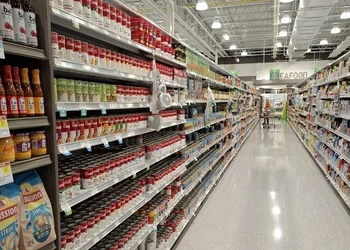
I recently spent a week in the US doing something I probably enjoy far more than the average person should: walking around grocery stores.
Yes, I am American, but I've been living in Australia for the better part of 15 years and I can tell you that reverse culture shock is a genuinely real thing. Sometimes you forget just how BIG the US really is.
While "home", I visited Walmart, Kroger, Publix, Family Fare, Meijer, Sam's Club, Walgreens and a collection of smaller local retailers and independents across Tennessee, Michigan, and Texas.
After a few stores, I started noticing the same things over and over again.
The shelves were full. The aisles were huge. Staff were everywhere. There were no checkout lines. Customers had choices. And, despite all the concern around retail theft in the US, the loss-prevention measures rarely made me feel as though the store expected me to steal something.
American grocery retail is not perfect, and every country cannot copy the US operating model. But there was something striking about how easy these stores made it to shop.
I'm just going to say it, sometimes, bigger really is better.

Don't miss any news, updates or insider tips from CX Network by getting them delivered to your inbox. Sign up to our newsletter and join our community of experts.
Availability is a major part of the customer experience
The first thing I noticed was the shelves.
They were stocked. Really stocked.
Endcaps were full. Produce displays looked abundant. Promotional areas were built out properly. Shelves that often have visible gaps in an Australian supermarket looked like they had been prepared for a grand opening, but really it was just another day.
It was normal everywhere! And it changed how I started shopping.
I found myself looking at more products, picking more things up and wanting things I had not planned to buy. When an entire display is full, colorful and faced-up beautifully, it creates a completely different feeling from a shelf with three lonely products spread across six facings.
I would love to see the sales data behind that difference. Does anyone have it?
In CX, we talk a lot about personalization, loyalty programs, apps and artificial intelligence (AI), but there is something wonderfully basic about product availability: customers cannot buy what is not there.
The staffing difference was impossible to miss
The next thing that reverse shocked me was staffing.
With the exception of one store, I rarely had to look for a staff member.
One example really stood out. In Walmart's health and beauty area, some products were kept in locked cabinets. For me personally and many others, that's a pretty horrible CX moment. You find the product, discover you cannot access it, wander around looking for somebody, wait for them to find the key and eventually wonder whether you need it that badly.
Except that wasn't what happened at Walmart.
There was a staff member dedicated to the area. Their job was to help customers access those products. This was a busy aisle. They were never standing around twiddling their thumbs.
The security measure was still there, but the service model made it work.
Compare that with a locked perfume cabinet in a Chemist Warehouse where finding somebody to open it feels like a side quest. I have abandoned purchases before because the effort involved was not worth it.
That made me curious about the commercial impact. If you protect a high-value category from theft but make legitimate purchases harder, how much do you save and how much do you lose?
The best loss solution is not necessarily the one with the most visible security. It is the one that protects the business while still making it easy for a genuine customer to buy. US grocery stores nailed it.
Service can be a security measure too
The staffing levels had another effect: service felt very proactive.
People said hello. Staff made eye contact. Help was close by. Yes, there is a cultural element here. Americans have a well-earned reputation for chatting to strangers, and that naturally spills into customer service.
But friendliness is not just "nice", it can also have a role in loss prevention.
A team member simply acknowledging someone can act as a deterrent to opportunistic theft. "Hi, how are you?" is good service to an honest customer. To someone hoping to go unnoticed, it also says: I have seen you.
The stores I visited generally seemed to operate from an assumption of: you are here to shop, so we are going to make that easy. If you try to do the wrong thing, we will deal with that separately.
That distinction mattered.
Space removes more friction than we give it credit for
Then there were the aisles. They were enormous. Texas-sized even! So much room for activities. I loved it.
At times you could comfortably fit two full shopping carts side by side and still have space for someone to comfortably walk between them.
It made me realize how much low-level friction we accept in smaller stores: waiting for someone to move their cart, squeezing past people or abandoning an aisle altogether because it is too congested.
Customer experience is often the accumulation of tiny irritations, space included.
The US has an obvious physical advantage here. Bigger stores and larger sites mean this is not something retailers everywhere can replicate.
I get it. In terms of land area, Australia is roughly 32 times larger than the UK with a population less than half the size. The US is close to 40 times larger and the UK has around one-fifth of the US population, packed into a fraction of the space. Retailers operating in markets like that can't just copy the store footprints and aisle widths of countries that are built very differently.
Regardless, the principle can still be replicated.
How easy is it for customers to physically move through your experience? Where are the bottlenecks? What are customers navigating around because your operation or structures have put something in their way?
I love a clear customer path. Let me get to where I want to go!
Checkout choice was the real standout
The biggest difference for me, however, was the checkouts.
Surprise surprise. The checkout nerd couldn't help but be impressed.
I visited stores on busy Saturdays and Sundays and did not once see a checkout queue spilling back into the shopping area. Main lanes were open. Self-checkouts were open. In some stores there were scan-and-go options and other ways to pay.
There were a lot of choices for customers.
Customers who wanted a cashier could have a cashier. Customers who wanted self-service could use self-service. Someone with a full trolley could choose differently from someone buying two products.
The experience flexed around the customer and their needs and wants at any given time.
When I asked if it ever got busy or if there were ever lines, staff were confused by the question. "No, of course not. Except maybe around a busy holiday like Christmas." I make note of no lines because there are SO MANY people in the US. It is the third most populous country on earth but waiting in a line? Absolutely not.
Somehow, the Utopia of no checkout queues has been achieved.
Part of that might be because when someone required assistance at a self-checkout, I was shocked at what I experienced.
In the larger stores I often saw multiple attendants covering the self-checkout area. When an intervention light appeared, somebody was there almost immediately.
No searching around. No awkward arm waving. No standing beside a flashing red light waiting for help.
It felt as though making a customer wait was considered unacceptable.
No lines, no waiting, no queues. What is this checkout sorcery?
Security was present without becoming the experience
Perhaps the most surprising part was what I did not see.
Of course there were cameras. Larger stores had visible security. Some high-value products were protected or locked away.
But the loss-prevention measures were never the dominant feature of the customer journey.
I was not constantly being funneled through gates. I was not routinely being interrupted before I had even had a chance to complete what I was doing. I did not feel watched through a camera feed on a checkout screen (maybe thanks now to the work I did to debunk that effectiveness. I'll say it was me. You're welcome.)
Security existed, but it largely sat behind the experience rather than on top of it.
Every security intervention has a customer consequence. It also has a team consequence.
If you lock a cabinet, who opens it? How quickly can they get there? If technology creates an intervention at self-checkout, how many team members are available to clear it? If you add a control that slows a customer down, what have you done operationally to offset that friction?
Technology alone cannot answer those questions. People, process and customer experience have to come with it. It felt like everything was designed around removing friction and barriers in the store so I could buy MORE.
While not great for my wallet or suitcase weight, it was a great experience and I daresay, helpful to the bottom line of the store.
No, we cannot just copy America
I'm not here to say, "the US is doing perfectly! We must all do it like this!" There are obvious caveats.
Labor economics differ. Store footprints differ. Population and customer volumes differ. Retail regulation differs. Cultural expectations around service differ. The economics of rostering more people in a US store cannot simply be lifted and dropped into Australia, the UK or Europe.
That is not my argument. What we can copy is the intent.
The stores I visited appeared to be designed around a few very simple principles: keep the product available, keep the path clear, make help easy to find, give customers choice and remove friction from payment.
Then layer security around that experience rather than forcing the customer experience to bend around security.
It is easy to become obsessed with the next big CX innovation. AI. Personalization. Automation. Predictive analytics.
All of those things matter. But sometimes the lesson is much less glamorous:
- Stock the shelf.
- Have someone available to help.
- Give people enough room.
- Open the checkout.
- Solve the problem quickly.
- Trust the majority of your customers who are there to do exactly what retailers want them to do: buy something.
With CX Retail Exchange USA bringing retail leaders together in Atlanta this September, these are exactly the kinds of conversations I hope the industry keeps having.
Because the future of retail CX is not only about what technology we add next.
Sometimes it is about getting the fundamentals so right that the customer barely has to think about the experience at all.
Quick links
- The Back Market story: Building customer trust in a low-frequency purchase category
- The discovery disruption: 3 steps to take you from SEO to agentic readiness
- AI and customer trust: Reflections from CCW 2026 Sydney