The loyalty paradox: Why customers trust their own AI, but fear yours
Behnam Behzadifar explains why organizations are finding it difficult to build customer trust in AI systems, and what they can do to change the situation
Add bookmark

There's a corporate AI blind spot that is mostly likely costing you customers, loyalty and money: customers trust their own AI assistant more than they trust your algorithmic decision systems or conversational AI in service.
Consumers are not rejecting artificial intelligence (AI); they are rejecting corporate ownership of it. A telling behavioral divide has quietly formed across digital commerce: buyers actively rely on personal AI agents to search for products and services as well as write emails, evaluate contracts and manage personal schedules.
CX Network's 2026 research into the state of CX is just one study to confirm this trend. The results show that AI-first customer journeys are both the third most influential trend for CX practitioners at present and the third most important customer behavior.
However, the same research saw consumer privacy enter the top 10 CX trends for the first time, and awareness of how AI works and uses customer data was the number one customer behavior influencing the work of practitioners.
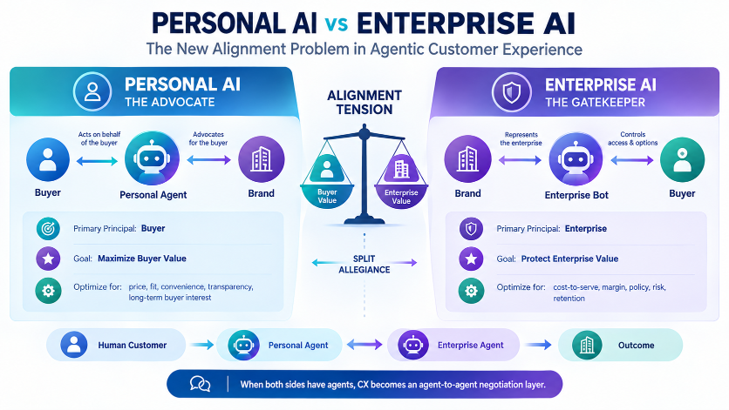
The asymmetry in trust stems from divergent incentives. The customer's personal AI assistant serves one master: the user. Its mandate is to save time, protect cash, and bypass promotional noise.
An enterprise AI, by contrast, is deployed with dual allegiances. Front-line bots are tasked with assisting the customer while simultaneously deflecting tickets, defending margins, preventing refunds and capturing proprietary user telemetry.
When an AI tries to serve the customer while secretly optimizing for company cash flow, the customer senses the extraction immediately.
The outcome is not neutral indifference it is active distrust and a tangible impact on loyalty.
This article explores:
- Where consumer distrust of AI originates – and where it does not.
- How transparency and disclosure could help build customer trust while using algorithmic systems to make high-impact decisions.
- Three steps any organization can take to build customer trust and loyalty in algorithmic systems.

Don't miss any news, updates or insider tips from CX Network by getting them delivered to your inbox. Sign up to our newsletter and join our community of experts.
Where distrust originates and the cost of algorithmic gaslighting
Distrust rarely stems from algorithmic error; it stems from architectural design choices that prioritize enterprise convenience over customer equity:
- The deflection maze: Trapping buyers behind repetitive conversational loops designed to protect internal contact center SLAs, while offering no direct route to human intervention.
- The invisible lever: Dynamic pricing, automated credit scoring, and algorithmic policy denials that give no plain-language explanation of their underlying factors.
- The extractive contract: Demanding access to device telemetry, behavioral breadcrumbs, and location data while returning minimal functional utility in exchange.
When AI operates as an unreadable black box, customers naturally assume the calculation is rigged against them.
This graphic demonstrates the key differences between corporate and personal AI, highlighting who the AI works for and what it is optimized for:
A concrete scenario: Building trust in algorithmic loan approval
Consider a fintech rolling out an algorithmic loan and credit pre-approval workflow.
Under the initial deployment, applicants connected bank data and submitted employment history. The proprietary risk model rendered binary decisions within seconds: approved at 9.4 percent APR or denied. It gave zero rationale.
Suspecting arbitrary scoring, loan application drop-offs jumped by 31 percent, and disgruntled users vented on forums about unfair bias.
The CX and product engineering teams scrapped the opaque interface and rebuilt it around a Reciprocal Value Protocol:
1. Explicit data for benefit pairing: When prompting users to connect primary checking accounts, the screen explicitly stated: "Connecting recurring payroll deposits reduces your estimated loan rate by 0.65percent."
2. Determinism over mystery: For applications that fell short of prime tiering, the engine generated actionable levers: "Our current debt-to-income ratio is 39 percent. Reducing recurring card debt by $180/month lowers this bracket to 6.2 percent APR."
3. Escalation parity: Applicants could tap a single button to transfer their machine decision log directly to a licensed credit specialist with zero dropped context.
By replacing opaque gatekeeping with deterministic math, customer conversion rose by 38 percent and complaints dropped to single digits.
3 Steps to build algorithmic trust
Here are three steps that can be applied in any organization to help build customer trust in algorithmic systems that have real-world implications for customers.
1. Codify "explainable AI" as a non-negotiable touchpoint
Eliminate unexplainable outcomes across high-stakes interactions. Whether an AI calculates an insurance claim, denies an account verification, or quotes a delivery window, provide an inline breakdown detailing the concrete metrics that dictated the decision.
2. Standardize machine to machine integrity
Prepare your architecture for the buyer's personal AI assistant. Expose clean, structured APIs that let autonomous customer agents verify inventory availability, return terms, and warranties without bot-blockers or misleading web copy. Trying to game or fool a customer's autonomous agent will lead to automated disqualification.
3. Enforce the zero-extraction data rule
Audit every customer data point requested across your digital ecosystem. If your organization cannot articulate a direct, immediate and tangible customer benefit resulting from a specific piece of personal telemetry, deprecate the field.
Conclusion: To trust AI, customers need trustworthy AI
Trust is not an abstract brand attribute; it is an architectural contract.
In an environment where buyers navigate commerce armed with their own autonomous agents, organizations can no longer hide behind opaque workflows, black-box algorithms, or manipulative deflection loops.
Customers want control of their experiences, data and outcomes.
The brands that win will be those that align their AI with the customer's economic interest, treating customer data not as proprietary territory to exploit, but as a mutual pact to honor through transparent utility, uncompromised honesty, and clear operational reciprocity.
Quick links
- The EU AI Act compliance checklist for customer service teams
- The new voice of the customer: How AI and synthetic data will transform CX in 2027
- How to connect with customers in the AI age