Why AI agents won't fix your decision-making (and 3 things that will)
Research suggests the data problem got solved, but what if it was just skipped? Sue Duris explains why incomplete signals are undermining even the most powerful decision-intelligence platforms
Add bookmarkListen to this content
Audio conversion provided by OpenAI


A couple of years ago, CX leaders ranked data and analytics near the top of the most influential CX trends. In the 2024 edition of CX Network's State of CX report, data and analytics sat high on the list of trends.
By 2026, however, it had slipped toward the bottom, while AI agents climbed to the top.
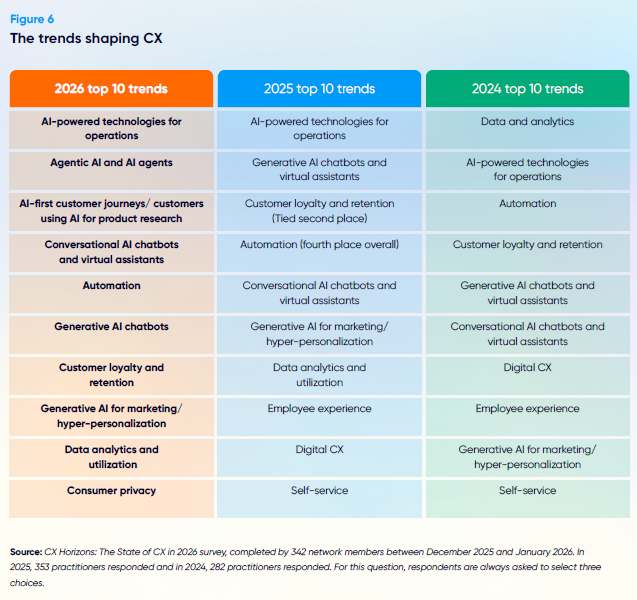
It's tempting to read that as progress – as if the data problem got solved and attention moved on to the next frontier. But, looking closer, the data problem didn't get solved. It got skipped.
Everyone raced to deploy AI agents. Far fewer stopped to fix what feeds them – or to ask whether leaders can trust what comes out. And that gap is now showing up where it matters most: in the decisions those tools were supposed to improve.

Don't miss any news, updates or insider tips from CX Network by getting them delivered to your inbox. Sign up to our newsletter and join our community of experts.
We're optimizing the wrong thing
The entire "decision intelligence" conversation is built on a quiet assumption: that the problem is decision quality. Make better decisions, faster. Buy the platform, model the choice, improve the output.
But quality was never really the issue.
You would never walk into a CRO's office and tell them they make bad decisions. Most executives are sharp, experienced, and decisive. The problem isn't the caliber of the decision-maker. It's that they are deciding on a fraction of the picture.
The signals exist – customer, operational, financial. But they sit in different systems, owned by different teams, measured in different languages. They rarely reach the person deciding as one connected, coherent picture. So, the call gets made on a slice, not the whole.
That's the real failure, and it isn't about quality. It's about completeness. And no amount of better decisioning – or better tooling – fixes a decision built on incomplete inputs. Inputs determine outputs. If the inputs are fragmented and partial, the output is compromised no matter how good the decision-maker or the model.
The process itself is broken
This isn't a hunch. It's well documented.
McKinsey has found that executives spend 40 percent of their time making decisions, and believe most of that time is poorly used. In one survey of more than 1,000 leaders, a majority said that much of the time they spend making decisions is used ineffectively. In fact, 61 percent say at least half of decision-making time is ineffective, which McKinsey estimates could cost a typical Fortune 500 company around 530,000 days of managers' time, and roughly US$250 million in wages, each year.
Dig into why, and the causes are strikingly consistent: unclear roles, too many people with a vote instead of a voice, decisions pushed to the wrong level, endless consensus-seeking.
None of those are data problems. They are organizational design problems: who owns which decision, what information reaches them, and how it flows. The failure isn't in the signal or the decision. It's in the space between them. And that space is the operating model.
Even when the data arrives, they don't trust it
Here's the layer most of the decision-intelligence conversation misses entirely. It assumes that if you just get the right data to the right person, the decision follows. But that's not what happens.
A recent Financial Times study of business leaders found that 74 percent had, at some point, held back a decision simply because they weren't sure what data to trust. The same study found 77 percent of respondents increasingly cross-check information across multiple sources, and 85 percent are increasingly wary that AI-generated content is making it harder to know what's credible in the first place. And, 82 percent said they trust a source that challenges their assumptions more than one that aligns with existing views.
The problem isn't only that inputs don't reach decision-makers. It's that even when they do, leaders don't trust them enough to act – and the rise of AI-generated content is making that worse, not better. This is where the AI-agent rush comes back to bite. Deploy agents on top of fragmented, unverified inputs, and you don't get trusted decisions faster. You get distrusted outputs faster. More data, more speed, less confidence.
So the goal was never "better decisions". Better than what? On what basis? The goal is complete decisions – and trusted ones. Those are different targets, and they call for different work.
The tooling won't save you – and the analysts quietly admit it
The market's answer to all of this is, predictably, a platform.
Gartner projects that by 2027, 50 percent of business decisions will have been augmented or automated by AI agents for decision intelligence. It further predicts that by 2030, modeled decisions will be 5x more trusted and 80 percent faster "enabled by decision intelligence platform adoption".
The benefit Gartner attributes to "platform adoption" comes from modeling and governing the decision — deciding what the decision is, what inputs it needs, who owns it, and how it's validated. That's organizational work. The platform is where it gets recorded, not where it gets solved. Gartner even warns that a meaningful share of ungoverned AI-assisted decisions will cause financial or reputational loss, precisely because governance, not tooling, is the missing ingredient.
Buy the platform and skip the governance, and you've automated the fragmentation. You've built a faster path to a confidently wrong answer.
Three steps to making better decisions with AI agents
Here's where you can start:
1. Map where the signals fragment
Audit your key decisions and trace backward: for each one, do the customer, operational, and financial inputs actually reach the decider as one picture, or does each arrive separately, late, or not at all? The gaps are your design problem, made visible.
2. Assign ownership of the decision, not just the data
Someone owns the CRM. Someone owns the finance system. But who owns getting the complete picture to the person deciding? Usually no one. Name that owner; that's the accountability the operating model is missing.
3. Build in validation, so leaders trust what they get
The trust gap doesn't close on its own. Decide, up front, how key inputs get verified, so when the picture reaches the decision-maker, they trust it.
Better decisions were never the goal. Complete ones are
So, the reframe is this. Stop asking how to make better decisions. Executives don't need help being smarter. Start asking whether the decision is complete, whether the right inputs, from every relevant function, reach the person deciding as one coherent picture they can trust.
That's not a data question or a tooling question. It's an organizational design question: who owns which signal, how it flows, who's accountable for getting it to the decision-maker whole, and how it's validated so leaders trust it enough to act.
The companies that win this won't be the ones with the most powerful decision-intelligence platform. They'll be the ones who did the unglamorous work of designing how information moves through the organization, so that when a decision gets made, it's made on all of it, not a fragment, and on signals people believe.
Better decisions were never the goal. Complete ones are.
Quick links
- 81% of global IT leaders say AI failure puts career "at risk"
- The CX Recovery Layer: What happens when the agent is wrong?
- Inside PowerPay: Using AI agents to amplify not replace humans
CCW EU 2026

CCW Europe will explore how service is transforming from execution to a strategic driver of trust, insight, and value.
The agenda features over 250 world-class speakers, delivering actionable strategies, global best practices, and inspiring insights on AI, innovation, and customer-centric transformation. From the Failures & Fixes stage to international benchmarks, each session equips leaders to navigate this fast-paced environment and drive meaningful change.
Learn More