How AI agents drive process excellence – and why it matters for CX
In CX, AI agents are often confined to frontline automation. But when their full potential is harnessed, they improve operations, business intelligence and AI search rankings
Add bookmark

As unified CX becomes the north star for more organizations, business functions such as operations and marketing are aligning more closely with the strategic objectives of CX.
There's more than one driver for this shift. One often overlooked angle is agentic commerce. The emergence of algorithmic buyers heightens the focus on process excellence, as consumer AI assistants assess vendors based on their track record for CX, which is closely tied to operational and process excellence.
To recommend a vendor, the AI assistant is looking to establish whether an organization can fulfil orders on time, process refunds without extensive liaison or repeat customer requests, and deliver quality service and products.
If customer reviews frequently focus on poor service, broken journeys, or poor follow up and communication, the AI assistant is less likely to recommend the company. Likewise, if policies and knowledge bases are unreadable by machines or highlight inconsistencies, the vendor will effectively be marked down in search results.
To succeed in this environment, organizations can't depend solely on CX to drive customer centricity. The ethos must be driven through marketing, commerce, supply chain, service and operations.
This article explains how AI agents can drive the level of process excellence modern organizations must now deliver as standard. With a focus on four key insights, it looks at where AI agents can drive real value beyond customer contact resolution, how the tickets AI agents resolve can become a source of business intelligence, and how these additional use cases support stronger ROI.

Don't miss any news, updates or insider tips from CX Network by getting them delivered to your inbox. Sign up to our newsletter and join our community of experts.
Insight 1: CX practitioners know AI can improve operations
In 2025 and 2026, CX Network's annual research into the state of CX found AI for operations was the number one trend influencing the role of practitioners – and agents and copilots play a key role in this result.
Explaining how different AI tools enhance back-end operations at American Express, Pam Hopkins, executive vice president of global consumer servicing and fulfillment, says it is used to reduce manual work and give employees better information so they can serve customers more efficiently.
She says: "Our goal is to use AI to make our operations more effective and give colleagues better tools and insights, creating more capacity to deliver the care and service that define the Amex experience."
This runs from automating the routine to AI-powered support and generative AI call summarization. At the lower-level AI is used for Know Your Customer updates and reviewing certain card application information. "By reducing manual steps and unnecessary back-and-forth, we can make these processes simpler and more efficient for customers and colleagues," Hopkins says.
Amex is also embedding AI directly into the tools frontline colleagues use every day. "Our Intuitive Servicing Portal brings key tools and information together, giving colleagues a single, holistic view of a customer's relationship with American Express," Hopkins explains.
"We're using generative AI within the portal to summarize calls, identify customer issues, and provide relevant information in real time – reducing the time spent piecing together information across multiple systems and helping colleagues work more efficiently and effectively."
Insight 2: AI agents are more than a frontline automation layer
The use case from American Express shows how AI agents can improve operations in one business area – but there's much more to the story.
Hemang Upadhyay, senior manager of product management (AI) for LG Electronics USA, says that when designed correctly, AI agents can also act as a real-time diagnostic layer across operations. This is where their role is elevated from frontline automation to a source of operational intelligence and improvement.
"On the helpdesk, AI agents interact with a high volume of customer or employee issues," he says.
"Every interaction contains signals about where processes are clear, where they are broken, and where customers or employees are repeatedly getting stuck. If those signals are captured and analyzed properly, the helpdesk becomes a source of operational intelligence, not just a support channel," Upadhyay adds.
The biggest contribution to process excellence, he says, comes when organizations close the loop. Rather than working to a binary choice of resolve or escalate the customer ticket, each interaction should help the organization learn.
Upadhyay says learnings should address the key questions of:
- Which processes are generating avoidable contacts?
- Which knowledge gaps are creating rework?
- Which policies are unclear?
- Which automations are failing?
"In that sense, AI agents can help shift the helpdesk from reactive support to continuous improvement. They can reduce friction for users, improve consistency for agents, and give leadership a clearer view of where operational processes need to be redesigned," he explains.
Insight 3: AI agents can identify process gaps and support Lean thinking
Similar principles can be applied to address – and close – gaps in business operations. Sudarshan Reddy Gurampatti, senior machine learning engineer for JPMorgan Chase & Co., says this is where the real value in AI agents lies.
"One area where I see a lot of value is pattern recognition," Gurampatti says. "Every helpdesk ticket tells you something about how the business is operating. It shows where customers are struggling, which processes are unclear, and which issues keep coming back. AI agents can identify these patterns much faster than someone manually reviewing hundreds or thousands of tickets."
As an example, Gurampatti says it could be that a large number of support tickets are linking back to a single password reset process.
"Instead of continuing to handle the same requests every day, the operations team was able to identify the root cause and improve the process itself," he says.
This principle could also extend to missing knowledge articles, confusing policies, product defects, order-status issues, system access bottlenecks, or handoff failures between teams.
Gurampatti says this is where agents start to support Lean thinking, helping leaders to understand and maximize customer value while minimizing waste and resource overuse.
"Rather than treating the same symptoms over and over again, teams can fix the underlying process that is creating the problem. That is where real process improvement starts," he adds.
Insight 4: Using AI agents to improve processes also improves ROI
The more value AI agents drive, the stronger the return on investment. This is simply because the organization is reaping secondary benefits from the technology, in addition to the primary benefits identified.
In line with the examples provided by Hopkins, Upadhyay and Gurampatti, an AI agent may primarily be deployed to improve a service process. The ROI projection for this may focus on cost of investment, operational costs such as tokens, and then the labor saved. Employee training, compliance and and systems integration costs may also be factored into the calculations and the organization may expect to break even on their investment within 12 months.
However, if in executing these tasks the AI agent can also be used to identify process improvements that create new efficiencies, the time to ROI will be shorter and the investment outlay will have a stronger business case.
As many as 40 percent of CX Network members expect their spending on AI agents to increase this year, according to the annual research.
Upadhyay highlights several key steps to take to safeguard the ROI of these investments:
- Identify the specific process pain points organizations want the AI agent to improve;
- Assess whether the underlying process is ready for automation;
- Ensure the data and knowledge foundation the agent will draw on is strong;
- And design human-in-the-loop escalation from the start.
From support channel to operational layer
The introduction of AI agents to an organization is nothing short of a revolution.
For the more ambitious organizations – and practitioners who embrace Lean thinking methodology – the benefits are AI agents that reach far beyond CSAT and CES tracking.
When tapped to their full potential, agents are drivers of process excellence and value-driving efficiencies that elevate the inner workings of the organization and unlock new value. As agentic commerce takes off, this becomes more than an efficiency driver. It becomes an essential marketing play that will drive discovery and visibility in AI search.
And as CX unifies to become an operational driver and foundation of company culture, these considerations will increasingly fall to practitioners.
Writing for CX Network, consultant and podcast host Gregorio Uglioni says customers don't care whether a company has a customer journey map, a VoC program or an AI-powered service suite. They care about outcomes.
"After years of working in the fields of transformation and customer experience, I have come to a simple conclusion: every customer experience is the result of an operating model," Uglioni says.
AI agents may appear to be complex, but innovations are democratizing access to the technology. For example, developers such as Botpress allow leaders to build agents using natural language prompts, which means these powerful tools can be leveraged by any organization.
You can explore more about all the points in this article in the CX Network report The realities of using AI agents for the helpdesk.
Quick links
- The discovery disruption: 3 steps to take you from SEO to agentic readiness
- Understanding the cost of AI: Token costs, governance and workforce readiness
- Before you cut your contact center workforce for AI agents, read the fine print
Botpress - The realities of using AI agents for the helpdesk
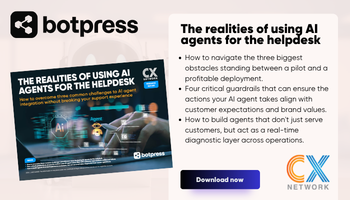
This CX Network report explores how practitioners are overcoming the three challenges of AI agent integration. Featuring insights from workforce, service and product specialists at Roche Pharmaceuticals, LG Electronics, PowerPay, J.P. Morgan Chase & Co., New York Life and Botpress, as well as a case study from Super Dispatch, it explains how to build for complex tickets and real-world scenarios, how to reduce overheads without reducing headcount, and how to implement the guardrails that are essential to success.
Download Now