What Gen Z can teach us about AI, CX, and building brand trust
It’s giving cringe. Claire Cunningham explores why Gen Z’s attitude to AI is not as black and white as it appears
Add bookmarkListen to this content
Audio conversion provided by OpenAI


For a while there, millennials were blamed for the collapse of almost every industry.
Department stores. Breakfast cereal. Diamonds. At one point, we were apparently responsible for the demise of the napkin industry, simply because we could not see the point in buying a separate product when paper towels were already in the kitchen. Guilty as charged.
As a proud millennial, I found these headlines both amusing and annoying. Not because our behaviors were being misunderstood, but because the criticism missed opportunities. We were not destroying industries for the fun of it. These products, services, and experiences were no longer relevant to the way we lived. And we were shamed for it!
Gen Z is facing its own version of this judgement and I'm here to say, I fully support their demands. No shade… as the kids say.
Gen Z are often described as entitled, impatient, easily distracted, overly reliant on technology, or too scared to speak to a human being. But what if instead of criticizing Gen Z for their low tolerance for barriers, we learned from it? After all, they make up almost 25 percent of the global population. That represents a sizable chunk of either your current or soon-to-be primary customer base.
Gen Z is not asking brands to do something unreasonable. They are asking them to be easy to deal with, transparent about their intentions, respectful of their time, and authentic. That's what we've wanted all along as customers but haven't had the platforms to shout loudly about it. Gen Z does.

Don't miss any news, updates or insider tips from CX Network by getting them delivered to your inbox. Sign up to our newsletter and join our community of experts.
Gen Z has grown up spotting unnecessary friction
Previous generations have lived through a dramatic evolution in life and in customer experience. We remember dial-up internet, calling a business during office hours, printing and manually signing forms, waiting for confirmations, and accepting that some things simply took time.
Gen Z has grown up in a different world. Their expectations adapted accordingly.
For them, the best experiences have always been instant, mobile, searchable, and self-directed. They can find information, compare options, read reviews, watch an explainer video, ask a question and complete a purchase without needing to get off TikTok.
This does not make them entitled. It makes them highly aware of when an experience is unnecessarily difficult.
Creating extra work is not a minor inconvenience. It's a major red flag.
A red flag that the business has not understood them. A red flag that their time is not valued. A red flag that a competitor may be easier to deal with. Unearned loyalty? Never heard of her.
Gen Z's low tolerance for friction is NOT a character flaw and I applaud them for it.
They are forcing organizations to confront a question that should matter to every leader: How many of the barriers in the customer journey are genuinely necessary? How many are simply there because customers just put up with them?
Convenience is not laziness. It is respect
Convenience is about brands respecting their customers' time and effort.
A young customer researching a course, opening a bank account, choosing an energy provider or buying a product does not want less information. They actually want more. They want clear answers, transparent pricing, genuine reviews, and the confidence that they understand what they are signing up for.
What they will not do is work hard to find that information.
Gen Z is very comfortable exploring independently. They will research, compare, verify, and form their own judgement. They usually don't want a salesperson stepping into the journey. They want the freedom to understand the offer in their own time and on their own terms.
They do not wish to be sold to. Honestly, no one really does.
For brands, this means clear FAQs are mandatory. Helpful marketing content is a requirement. Mobile design is not optional. Reviews are not superfluous. They matter in a big way.
They are all parts of the increasingly important trust experience.
Trust is built through transparency, not perfection
One of the most important lessons from Gen Z is that trust does not require brands to appear perfect, just real.
In fact, trying too hard to appear perfect can have the opposite effect.
This is a generation accustomed to watching unfiltered content and looking for the reality behind a polished brand message. They do not necessarily expect every customer review to be five stars, every video to be professionally produced or every brand to present a flawless image.
They expect what they are seeing to be real and authentic to the brand.
They can smell fake, disingenuous content from a mile away and won't give it a second look.
Authenticity and transparency creates confidence. The same applies to artificial intelligence (AI).
Brands don't need to hide the fact that AI is assisting a customer. What matters is that customers understand what is happening, that the AI provides genuine value, and that there is a sensible pathway to a human when needed.
Customers are often more forgiving of technology limitations than they are of brands that make them feel misled or powerless. Feel free to experiment and make mistakes and then own it. Gen Z will love that imperfection.
Gen Z is not anti-AI. They are anti-poor experience
However, there is also a risk that organizations interpret Gen Z's preference for self-service as a reason to remove people entirely and only use AI.
That would be a BIG mistake. Big! HUGE.
A frictionless experience is not one where customers can't ever speak to a human. It is one where customers do not have to speak to a human to complete a simple task, but they can easily reach one when the situation calls for it.
The best brands recognize the difference.
How? Let customers update their details without calling. Let them find straightforward answers without waiting in a queue. Let them track progress and resolve simple issues independently.
But when a customer is confused, distressed, or making a decision with significant consequences (university courses, for instance), make human support visible and accessible.
AI and self-service should reduce unnecessary effort. They should not become a barrier between a customer and the help they genuinely need.
This becomes particularly important as organizations rapidly adopt AI.
It would be easy to assume that a generation that values self-service will enthusiastically accept any AI-powered experience. But Gen Z's comfort with self-reliance does not mean they are uncritical of technology.
The very opposite in fact. They are quick to criticize it.
You may have seen the recent graduation speeches across the US. Graduates booed commencement speakers that celebrated AI and cheered for those denouncing it.
But these short video clips are not telling the whole story and should not inform your AI strategy. Gen Z does not mind using generative AI for themselves or agentic AI as a customer service option. But they do mind leaders professing the greatness of getting rid of their entry-level jobs with AI.
There is a big difference and brands need to get the balance right. Use AI in your branding and workforce carefully.
This is where organizations risk making a serious mistake.
AI can make customer experiences faster, easier, and more personalized. It can help customers find answers instantly, summarize complex information, guide them through a process and reduce the frustration of waiting for support.
But AI can also create more barriers if overly implemented and create an erosion of brand trust.
Gen Z teaches us about the balance of AI in the experience. They expect the experience to feel useful, truthful, and human.
Gen Z is giving brands an early warning system
The important point is that Gen Z is not the only group that dislikes poor digital experiences, hidden information, slow service, fake content, or frustrating automation.
They are simply far less willing to tolerate it.
Where a millennial might persevere through a confusing website or reluctantly call a support line, Gen Z has no such patience and will abandon the journey, swap to a competitor, and move on without ever giving the organization the chance to hear what went wrong.
Poor experience? They're not going to tell you. They will just leave.
Rather than calling them lazy or unengaged, perhaps the better question is how can brands become more deserving of their time and loyalty?
The lesson for CX leaders
Millennials did not really kill the napkin industry. We simply exposed a gap between what businesses were offering and what customers felt they needed (or could afford).
Gen Z is doing something similar now, particularly as AI begins to influence more moments in the customer journey.
They are showing us that speed without usefulness is not giving. Automation without control is not serving. Personalization without accuracy is a total flop. Content without authenticity is sus. And AI without trust is super cringe.
Their low tolerance for barriers is not a problem to be fixed. Embrace it. Work with it. Use it.
It is a challenge to brands to become clearer, simpler, and more transparent.
The future of customer experience will not belong to the organizations that use the most AI. It will belong to the organizations that use it to make customers feel understood, empowered, and confident that the brand on the other side can be trusted.
Quick links
- The Weavers: The overlooked generation holding CX together - right now
- Are AI-generated images putting customers off?
- Has Google just made your loyalty program invisible?
Botpress - The realities of using AI agents for the helpdesk
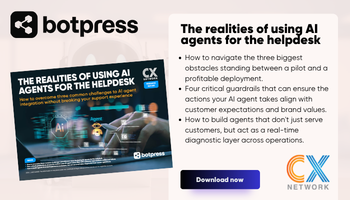
This CX Network report explores how practitioners are overcoming the three challenges of AI agent integration. Featuring insights from workforce, service and product specialists at Roche Pharmaceuticals, LG Electronics, PowerPay, J.P. Morgan Chase & Co., New York Life and Botpress, as well as a case study from Super Dispatch, it explains how to build for complex tickets and real-world scenarios, how to reduce overheads without reducing headcount, and how to implement the guardrails that are essential to success.
Download Now