The new voice of the customer: How AI and synthetic data will transform CX in 2027
Active listening places a burden on the customer. Passive listening leaves strategic blind spots. Behnam Behzadifar explains why synthetic data is moving from sci-fi to strategy and sets out 3 steps to prepare for its use in 2027
Add bookmark

Customer listening is reaching a major inflection point. For decades, voice of the customer (VoC) programs depended heavily on direct, post-interaction surveys asking buyers to score satisfaction, effort and loyalty on numerical scales. Yet as survey fatigue deepens and response rates continue to decline across industries, enterprise CX leaders are finding that active surveys capture an increasingly narrow slice of actual customer sentiment.
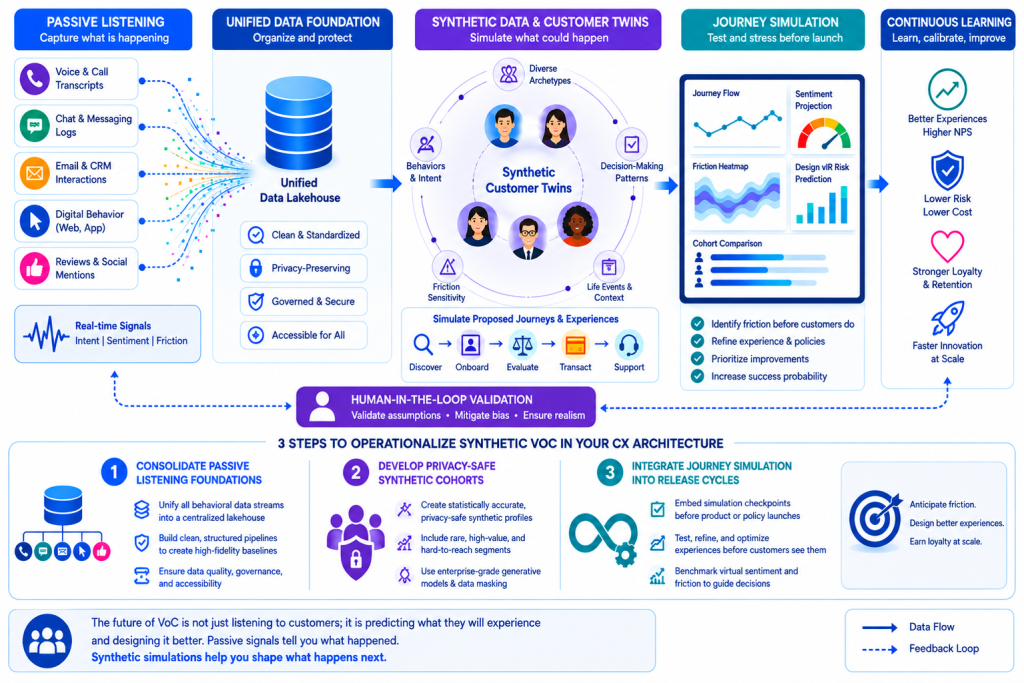
The emergence of modern CX architectures is shifting the focus toward continuous, passive listening. By analyzing interaction telemetry, contact center transcripts, digital breadcrumbs and sentiment velocity, organizations can capture customer intent without placing the burden of feedback on the buyer.
However, passive listening alone leaves a strategic blind spot: it tells teams what has already occurred, but offers limited predictive power for untested journeys or unreleased services.
As organizations build their 2027 CX roadmaps amid the rapid maturation of autonomous AI environments, pioneering enterprises are turning to synthetic data leveraging generative AI to simulate customer behavior, stress-test touchpoints, and anticipate friction before it impacts live users.
This article explains:
- How synthetic data and generative AI are changing VoC strategies
- How synthetic customer cohorts and digital twins can complement passive listening
- Three steps to take to prepare for how these trends will develop in 2027

Don't miss any news, updates or insider tips from CX Network by getting them delivered to your inbox. Sign up to our newsletter and join our community of experts.
The limits of passive signals in next-gen architecture
While passive listening provides rich operational context, enterprise teams frequently encounter two structural constraints:
- The novelty problem: Passive logs reflect past interactions under historical conditions. They offer little empirical data on how buyers might react to a radical pricing change, a redesigned onboarding flow or an autonomous self-service layer.
- Privacy and governance thresholds: Stricter global regulatory frameworks and consumer privacy expectations limit how freely sensitive first-party interaction histories can be mined or shared across operational silos.
This is where synthetic data is emerging as an indispensable layer in CX architecture. As highlighted in research from the Gartner Futures Lab, synthetic, AI generated datasets that replicate the statistical characteristics of real customer behaviors without exposing personal identities are increasingly utilized to supplement real-world data and simulate hard to reach buyer cohorts. Rather than waiting for live customers to experience broken touchpoints, CX teams can simulate customer cohorts to evaluate journey viability in sandbox environments.
From static feedback to synthetic customer twins
According to strategy insights from Bain & Company, synthetic customer modeling is evolving across two primary mechanisms:
- Synthetic cohorts for broad market exploration.
- Synthetic digital twins for granular journey simulation.
Unlike traditional marketing personas which often remain static, synthetic digital twins operate as dynamic, interactive models. By ingesting historical interaction patterns, behavioral traits and passive listening streams, these models construct virtual buyer personas that mimic human decision-making and friction sensitivity.
However, synthetic modeling is not an unmonitored silver bullet. To mitigate the risk of algorithmic bias or generative hallucinations, mature organizations maintain a human in the loop validation framework using synthetic cohorts not to replace human reality, but as a high-speed stress-testing layer that generates directional insights in hours rather than months.
A concrete scenario: Pre-emptive journey stress testing
Consider a financial services provider planning to transition its self service portal from human-assisted chat to an autonomous resolution engine for account restructuring.
Under a legacy VoC model, the company would deploy the feature, monitor drop off rates and wait for negative CSAT surveys to identify points of confusion. In an advanced architecture integrating synthetic data, the CX team creates a cohort of 500 synthetic customer twins representing varied customer archetypes from digital natives to risk-averse legacy account holders.
When the synthetic cohort interacts with the proposed conversational flows, the simulation detects a notable rate of decision hesitation and abandonment around ambiguous identity verification prompts. The team refines the conversational prompts and verification logic before public release.
Once the feature goes live, the CX team continuously monitors real time passive telemetry and interaction logs, comparing live customer behavior against the synthetic model's predictions to calibrate and refine future simulation accuracy.
Practical implementation: 3 steps for 2027 readiness
To begin operationalizing synthetic data within modern customer listening architectures, CX and digital transformation leaders can initiate three practical steps.
1. Consolidate passive listening foundations
The action: Unify disparate behavioral data streams including speech analytics logs, digital telemetry and resolution histories into a centralized data lake house.
Execution details: Task data engineering and CX analytics teams with establishing standardized data pipelines that clean and structure passive interaction logs. High-fidelity synthetic customer models require reliable, statistically representative behavioral baselines to simulate realistic decision pathways.
2. Develop privacy safe synthetic cohorts
The action: Build statistically sound, privacy compliant synthetic customer profiles to represent diverse buyer segments and complex edge cases.
Execution details: Collaborate with IT security and enterprise architecture teams to deploy enterprise-grade generative modeling frameworks and data masking protocols. These privacy-safe cohorts can simulate high value or low-frequency personas (such as specialized enterprise buyers) that are traditionally difficult to engage through standard focus groups or surveys.
3. Integrate journey simulation into product & policy release cycles
The action: Embed synthetic simulation checkpoints into digital experience and product development workflows prior to public deployment.
Execution details: Partner with digital product and service design teams to establish pre-launch simulation sprints. Use synthetic cohorts to test proposed UI updates, SLA modifications, or policy revisions, benchmarking virtual sentiment and completion friction to guide iterative adjustments before customer rollouts.
The future of customer listening is proactive
The evolution of modern CX architecture suggests a future where customer listening is no longer purely historical or reactive.
As organizations look toward 2027 and prepare for an agent-mediated economy, the brands that maintain the strongest customer relationships are unlikely to be those relying primarily on legging metrics and retrospective survey ratings.
Instead, they will likely be the enterprises that effectively combine passive behavioral listening with synthetic journey simulation identifying intent, anticipating friction and refining experiences before the customer ever encounters a barrier.
Quick links
- The insights API aiming to solve the synthetic data trust problem
- How CVS Health created an always on customer using agentic twins
- The 10 major changes on the horizon for CX