5 Lessons on contact center AI from the companies developing it
Event producer Chloe Chappell reflects on what we learned from the solution developers and providers that featured at All Access: Future Contact Centers 2026
Add bookmarkListen to this content
Audio conversion provided by OpenAI

AI has already vastly altered the contact center landscape in the last decade and it is showing no signs of slowing its transformative effect, with 46 percent of practitioners expecting spending on generative AI, and 29 percent expecting spending on agentic AI, to increase in 2026.
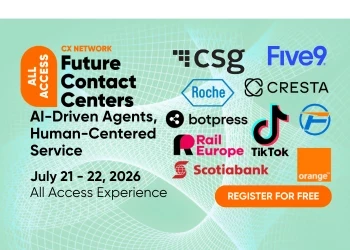
All Access: Future Contact Centers sought to unpick these developments in detail – and who better to speak to than the enterprise tech players developing the latest solutions.
Cross-industry leaders from finance, retail, telecoms, pharmaceuticals, tech and logistics joined us for the webinar series in July, 2026, alongside five undisputed experts in contact center tech.
A throughline that appeared was that all speakers, in their own way, argued that AI's real value in the contact center is elevating the human role and that the organizations succeeding are the ones basing AI transformation around not on cost reduction, but on service quality.
This article rounds up then main insights from the five tech pioneers – and one of their customers – that featured at the event. Meanwhile, this additional round-up article explains what happened during the sessions featuring service leaders and CX practitioners.
Read on to find out:
- How Botpress and Super Dispatch achieved just under 90 percent CSAT from their AI automation.
- Why CSG believes voice remains the high-stakes channel.
- How AI is rewiring customer service jobs, not replacing them, according to Cresta.
- Why Parloa believes AI agents should be trained like human new hires.
- Why RingCentral says AI and human agents can be managed as a "coordinated fleet" to deliver service that responds to complex needs.

Don't miss any news, updates or insider tips from CX Network by getting them delivered to your inbox. Sign up to our newsletter and join our community of experts.
Botpress and Super Dispatch: Escalation is not a failure but a learning moment
Designing automation around customer needs sounds obvious, but too often it isn't the reality.
"We made [customers] learn our websites, we made them fill out our forms, we made them navigate our IVR menus… We basically made customers work for us," said Sylvain Perron, co-founder and CEO of Botpress."The winners of the future will not have customers that understand their software. They'll be back to having software that understands their customer."
This gap, he said, is not the result of technology, but of business processes. "One critical mistake is to treat escalation as AI failing, when we should treat escalation as an opportunity to teach AI how to do it better in the future," Perron warned. AI and humans should share one system, with "the same access to tools, the same access to knowledge".
Perron was joined by Andrew Dell, support operations architect at Super Dispatch, a vehicle transport platform. He emphasized that coverage should be the priority in support, not automation.
He described the problem statement as: "How can we actually cover all of our customers' needs, not try to automate them away?"
In the 90 days after deploying Botpress' solution, Super Dispatch reported more than 7,000 AI-assisted conversations, including 600 handled after-hours, with just under 90 percent CSAT.
Handoffs between AI and humans requires full context, with summaries and transcripts. Per-resolution pricing, he argued, works against smooth human-AI collaboration.
"Per-resolution pricing is paying the vendor to close the ticket for you, rather than to hand off to a human at the right moment," Dell said. That hand-off should be governed by the principle that AI handles volume and speed. "Then our people handle judgment, trust, and the hard conversations," said Dell.
Catch up with their discussion on CX+
CSG: Fixing the forgotten front door
Keith Wilson, vice president for solution engineering at CSG, opened his session noting that customers are arriving to support already frustrated. And in this context, voice remains the high-stakes channel.
"As many as 76 percent of customers are going to prefer phone for complex high-stakes issues," he explained. And the IVR entry-point is often a missed opportunity to optimize their support experience. "In most organizations," Wilson said, "the front door to the contact center is a forgotten experience. It's just a pathway to get to the agent."
AI can help, but most AI in the market is essentially a bolt-on. Vendors are "stitching it all together, and they're calling it a strategy when really it's just bolt-on artificial intelligence that adds complexity".
KPIs and incentive structures are important here, Wilson said. "If most of the vendor's revenue is based on time spent with an agent," they are not incentivized towards efficiency.
The solution, he continued, is the introduction of an AI-powered voice concierge, which "picks up the phone and hears and understands what your customers are saying, getting a clear sense of intent".
A voice concierge can "routes them to the best path for them to be helped" and then pass the gathered context to the AI or human agent that takes over.
Wilson highlighted that the voice concierge is additive: "This is not about ripping and replacing anything. [CSG's solution is] built to seamlessly work with whatever contact center stack… you have invested in over the years."
Catch up with the discussion on CX+
Cresta: AI is rewiring customer service jobs, not replacing them
Antony Passemard, vice president of customer strategy at Cresta, sat down with us to discuss new research from Cresta that dispels common fears around AI-related job loss.
Based on a survey of 300 CX and IT leaders, Cresta's research found that "more than half of the organizations we talked to are expecting an increase in their headcount."
Human roles in contact centers are becoming more complex as AI picks up more routine tasks.
"As many as 90 percent of the leaders we talked to were mentioning that calls have gotten more complex… that's really because AI is actually succeeding," Passemard explained.
In this context, skills in the contact center are changing. Cresta's research found 92 percent of leaders now expect different skill sets, with more emphasis on emotional intelligence.
Similarly, CX Network's Horizons report found that the most selected change respondents expect generative and agentic AI to bring to their organization was the requirement for teams to upskill, at 36 percent. According to Cresta, 97 percent are already redeploying staff into higher-value roles because AI is handling routine requests, and 95 percent of its survey respondents said AI is creating new advancement paths in roles such as AI operations, workflow design and AI quality assurance.
Catch up with the discussion on CX+
Parloa: Reliability over resolution
Enterprise CX is in a bad way. According to Rodrigo DeCossio, VP EMEA at Parloa, 43 percent of enterprises have no support phone number on their website and only eight percent of chatbots actually resolve the customer's issue. At the center of this is an irony: "We spend millions getting customers in the door, and then we make it a obstacle course for them to actually talk to us," DeCossio said.
While chasing resolution rates can provide easy wins, lack of monitoring can leave teams guessing at what is driving results. AI agents, according to DeCossio, should be trained like human new hires.
"When companies obsess purely over resolution, they only tackle the easiest use cases… resolution without reliability is just a lucky guess," he said. "You would never take a new hire, hand them a headset, and push them live on day one… It's not really a tech project. It's a change management program that just happens to involve AI."
To drive reliability, DeCossio recommended breaking tasks into smaller parts, warning "The more you ask a single agent to do in one go, the less reliable it gets". CX agents should be owned by the CX department, not IT.
"The talent you need is almost certainly already sitting in your contact center," he said.
Similarly to other speakers, DeCossio stressed the importance of voice: 50 percent of customers still prefer to pick up the phone, he said, "yet, voice gets the least investment in most AI programs".
This chimes with CX Network's finding that digital CX failed to make the list of top 10 trends this year, despite topping the list in 2023, indicating that flashier channels perhaps aren't where true value sits.
DeCossio then noted examples of companies doing it right. Decathlon records over half a million voice interactions per year, for example, with 74 percent auto-identification and 20 percent of repetitive tasks removed. HSE, a leading live commerce platform in Europe, automated three million calls a year, running 600 calls simultaneously.
Catch up with the discussion on CX+
RingCentral: The voice renaissance and the missing "system of outcomes"
Ali Tore, senior vice president and general manager for conversational AI at RingCentral, framed his session by saying "70 percent of all customer interactions still occur via voice," because "when something is urgent, or complex, or emotional, people don't want an automated workflow, they want a conversation." Agentic voice AI can act rather than simply assist, with AI and human agents working as a "coordinated fleet".
There is a missing third layer, however. Between systems of engagement (channels) and systems of record (CRMs), there should be a "system of outcomes", an "intelligence layer that ensures it drives results", Tore said, so that AI acts rather than just records.
Tore pointed to RingCentral's architecture that feeds insights back to coach human agents on a daily rather than monthly basis. Agents can be configured in 30 seconds. This architecture has led to $2 million additional revenue for a mental-health customer, a 30 percent uplift in employee efficiency for the Detroit Pistons and a 40 percent sales improvement for Endeavor Capital.
Catch up with the discussion on CX+
Quick links
- Top 30 contact center leaders to follow in 2026
- Balancing the books on AI: How to deliver a return on your investment
- Tackling tech stack sprawl in CX
Mastering CX: AI Agents 2026

Register now for Mastering CX: AI Agents 2026 for an immersive experience where you'll get hands-on exposure to AI agents in action.
Register Now